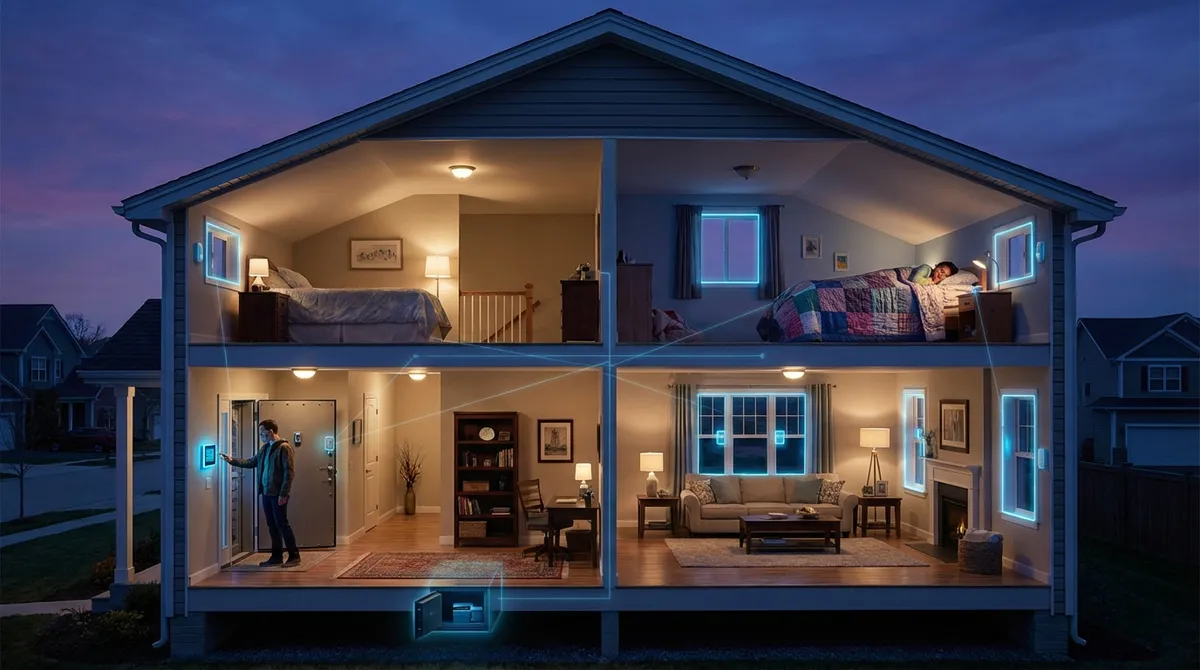
This guide walks you through five practical, layered strategies to protect and maintain your home’s security. Each layer reinforces the next, creating a home that’s harder to target, safer to live in, and easier to keep under your control.
Strategy 1: Strengthen Physical Barriers Before You Need Them
Before smart gadgets and apps, your first line of defense is still old-fashioned: doors, windows, and entry points. Intruders look for the path of least resistance, and that’s almost always a weak door, frame, or window.
Start with exterior doors. They should be solid-core or metal, with a deadbolt that extends at least one inch into the strike plate. Reinforce the door frame with heavy-duty strike plates secured by 3-inch screws that bite into the wall studs—not just the trim. This simple upgrade dramatically increases the force required to kick in a door.
Windows on the ground floor and basement deserve equal attention. Use secondary locks, pin locks, or key-operated locks on sliding windows and doors. Consider window security film on vulnerable glass near doors, which makes glass harder to shatter and slows entry. Don’t forget garage doors: keep the emergency release shielded and the door itself in good working order, with the interior door from the garage to the house treated like a main exterior door.
Regular inspection is part of maintenance: look for rotting frames, loose hardware, or doors that don’t close cleanly. Security fails gradually—through wear, not just one dramatic event. Fixing those early signs keeps your home harder to breach and easier to secure day to day.
Strategy 2: Control Visibility and Lighting to Your Advantage
What an outsider can see—and what they can’t—matters more than most homeowners realize. Good security balances privacy with visibility, making it easy for you and your neighbors to notice suspicious activity, but difficult for someone to approach your home unseen.
Outdoor lighting is a powerful deterrent when used smartly. Focus on entry points: front door, back door, side doors, garage, and any sliding doors or basement entries. Motion-activated lights with adjustable sensitivity are ideal—they startle intruders, draw attention, and reduce your energy use compared to all-night floodlights. Keep fixtures clean and bulbs in working order; failed bulbs create dark pockets that undermine your efforts.
Landscaping plays a big role. Trim shrubs and trees away from windows and doors to eliminate hiding spots. Avoid tall, dense bushes directly in front of ground-floor windows. Think in terms of “natural surveillance”—you want someone attempting to break a window to be easily visible from the street or neighboring homes. At the same time, avoid leaving valuables clearly visible through windows; large TVs, expensive equipment, or easily grabbed items should be positioned out of direct street view.
Inside, consider using timers or smart bulbs for interior lights when you’re away, creating the appearance of occupancy. Just as important: don’t advertise your absence with piled-up mail or packages. Hold mail, schedule package pickups, or ask a trusted neighbor to bring them in. A home that looks watched and lived-in is significantly less appealing to opportunistic intruders.
Strategy 3: Build a Smart but Reliable Security Ecosystem
Technology should protect you—not overwhelm you. When used thoughtfully, smart devices and security systems form an extra layer, adding detection, documentation, and deterrence to your physical defenses.
A monitored or self-monitored security system with door and window sensors is a strong foundation. Even basic packages that alert you to openings and motion can make a big difference, especially when paired with loud sirens that draw attention and startle intruders. Doorbell cameras and outdoor cameras add visibility at key points, letting you see who’s approaching and giving you recorded evidence if something happens.
The key is to choose tools you’ll actually manage. Overcomplicated systems that constantly send false alerts encourage “alert fatigue,” where you start ignoring notifications. Customize sensitivity settings, define alert zones, and disable unnecessary alerts so you only get notified when it truly matters. Regularly test your system, update firmware, and replace batteries on a schedule, not just when devices fail.
Protect your digital security as well. Use strong, unique passwords for security apps, enable two-factor authentication, and keep your Wi‑Fi network secured with WPA2 or WPA3 encryption and a strong passphrase. A compromised Wi‑Fi network can weaken your entire security setup. Finally, map out what you want your system to do in different scenarios—arming modes for “home,” “away,” and “night”—so your protection matches how you actually live, not just a generic default.
Strategy 4: Protect What Intruders Really Want—Identity, Access, and High-Value Targets
Security isn’t only about keeping people out—it’s also about reducing the damage if someone does get in. Criminals look for items they can quickly grab, sell, or exploit. You can limit their payoff by controlling how and where you store critical items and information.
Start with keys and access devices. Never leave spare keys under mats, in planters, or in obvious “hiding spots.” If you need backup access, use a properly rated lockbox in a discreet location, or choose smart locks with secure access codes you can change easily. Avoid sharing long-term codes with service providers; instead, create temporary or unique codes that can be deleted.
Important documents—passports, Social Security cards, birth certificates, insurance policies—and small high-value items like jewelry should be stored in a quality home safe that’s bolted to the structure or too heavy to move easily. A safe with both fire and theft protection offers broader security, especially if you also use it for digital backups like external drives.
Be cautious with what you share publicly. Announcing vacations, new expensive purchases, or your daily away-from-home routine on social media can unintentionally help someone plan a break-in. Review your privacy settings and think of your digital footprint as part of your physical home’s security. Shredding or securely disposing of sensitive mail and documents before discarding them also helps prevent identity theft that can follow a physical intrusion.
Strategy 5: Create a Safety and Response Plan for Your Household
Even the strongest security setup needs one more layer: people who know what to do. Protection is far more effective when your household operates from a clear, practiced plan rather than improvising in a crisis.
Begin with clear rules for locking up. Decide who is responsible for checking doors, windows, and the garage at night or when leaving the house, and make it a consistent habit. Teach children not to open the door to strangers, even if the person claims to be from a delivery service, utility company, or a familiar-sounding organization. Role-play simple scripts they can use to stay safe while being polite.
Create a plan for what to do if something seems wrong—unusual noises, a tripped alarm, or a door found open unexpectedly. In many cases, the safest response is to leave the home and call emergency services from a secure location rather than trying to investigate alone. Share this plan with all household members so no one is left guessing during a stressful moment.
Regularly review your emergency contacts and keep important numbers easily accessible. Make sure at least one person in the household knows where key shutoffs are—water, gas, and electricity—in case of damage or suspected tampering. Consider getting to know neighbors you trust; a simple mutual agreement to watch out for each other’s homes and report suspicious activity can be a powerful part of your security network.
Conclusion
A secure home is not built on a single lock, device, or habit. It’s a layered system: stronger physical barriers, thoughtful lighting and visibility, a manageable security ecosystem, protected valuables and information, and a household that knows how to respond.
When you treat security as ongoing maintenance instead of a one-time project, weaknesses are caught early, systems stay reliable, and your home becomes a harder, less appealing target. Small, consistent actions—checking frames, updating passwords, testing alarms, reviewing routines—work together to create the shield your home deserves.
Protecting your home protects your time, your privacy, and your peace of mind. Build your layers now, before someone else tests them for you.
Sources
- FBI Uniform Crime Reporting – Property Crime - Data and trends on property crime and burglary in the United States
- U.S. Department of Justice – Preventing Home Burglary - Practical burglary prevention tips and research-based recommendations
- U.S. Department of Energy – Exterior Lighting - Guidance on effective and efficient outdoor lighting, relevant to security and visibility
- Consumer Product Safety Commission – Home Safety Guides - Federal safety recommendations for households, including emergency planning
- National Crime Prevention Council – Home & Neighborhood Safety - Crime prevention strategies for homes and communities, including target-hardening advice